
Carrboro People Directory Choices
Carrboro people directories answer different questions. A staff directory identifies a person in a public role. A university result can confirm an affiliation. The property roll identifies an owner or tax-mail recipient, while a voter file records a civic relationship. Historical volumes preserve older residents, firms, churches, and clubs. None is a complete list of everyone who lives in town, and each label should be read with care.
| Name source | People or roles listed | Record keeper | How to consult it |
|---|---|---|---|
| Carrboro Town Directory | Town staff, departments, and public contacts | Town of Carrboro | Free category or name search |
| UNC Directory | Published faculty, staff, and permitted student entries | UNC-Chapel Hill | Free name search with privacy omissions |
| CHCCS staff pages | District and school staff | Chapel Hill-Carrboro City Schools | District and individual school pages |
| PIN and tax rolls | Property owners and tax-mail recipients | Orange County | Free ownership, GIS, and bill tools |
| NCSBE voter data | Registered and former voters within published limits | North Carolina State Board of Elections | Free lookup, weekly files, and historical snapshots |
| Professional and entity indexes | Licensees, agents, and named company officials | State boards and Secretary of State | Free official searches |
| DigitalNC directories | Past residents, firms, churches, and groups | Partner libraries and DigitalNC | Free scans and text search |
Begin with the relationship you can verify. Town department, UNC unit, CHCCS school, parcel, profession, or publication year narrows a common name better than a broad statewide query. Record the source date too. Carrboro has high student and institutional turnover, so even an official current directory can change fast.
Search Carrboro Staff Directories
The official Carrboro Town Directory searches by category, first name, and last name. Category browsing is useful when spelling is uncertain or only a department is known. Department entries publish a main number. Person entries can include surname-first name, pronouns, title, email, direct and additional phone numbers, physical address, fax, and a department link. Planning entries, for example, distinguish the director from planning, transportation, and code staff.
| Directory field | Control | Required | How it narrows the list |
|---|---|---|---|
| Category | Department list | No | Browses a town unit when a name is unknown |
| First Name | Text | No | Matches a published given name |
| Last Name | Text | No | Matches a published surname |
Orange County and the North Carolina state employee directory extend the government search beyond town staff. Council and board rosters add appointed or elected civic roles, while agenda packets can preserve an older appointment after a live directory changes. If a Carrboro employee does not appear, call the department main line or Town Clerk. A government directory documents a public role and work contact, not a private home address.
A typical Carrboro staff entry may publish these work details:
- Name and pronouns when supplied
- Title and department
- Email and direct telephone
- Additional phone or mobile work number
- Municipal office address and fax
- Link to the person’s department
Note: Search agenda packets by surname when the current category directory no longer shows a former board member or town employee.
Carrboro Education Directory Paths
The UNC-Chapel Hill directory is the largest nearby institutional directory. A result may show display name, affiliation, department or unit, campus address, work phone, and email when the person permits publication. Privacy choices mean an absent result does not disprove an affiliation. Chapel Hill-Carrboro City Schools uses district and individual school staff pages, which typically identify name, role, school or department, email, and phone extension.
The UNC directory shown below is a useful first stop when Carrboro information points toward the university. Open the official UNC directory search before comparing a name with other public sources.
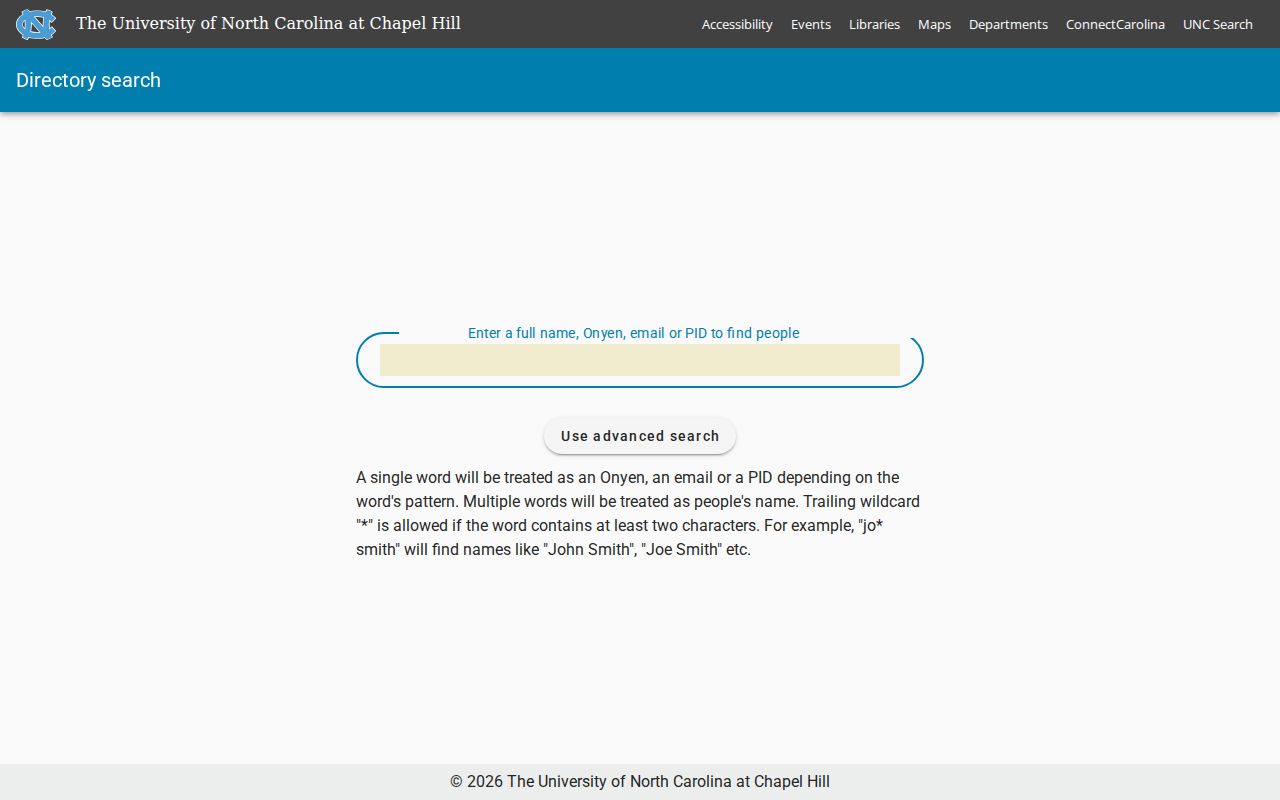
The interface ties a name to an institutional role, but publication controls and common names still call for a second detail such as unit, phone, or email.
Yearbooks, alumni publications, catalogs, student newspapers, and manuscript collections provide the historical counterpart. UNC Wilson Library, DigitalNC, and the Daily Tar Heel archive can connect a former student, teacher, or staff member to a dated event. Private alumni services may require authentication, so public yearbooks and newspapers are the practical fallback.
Carrboro Owner Directory Records
Orange County land tools work as people directories because they join an address, owner name, tax-mail address, and parcel identification number. The PIN ownership and history application shows current and past ownership information. GIS changes a place on the map into a parcel. The tax bill search accepts name, address, or parcel-oriented details and may show taxpayer, mailing address, property description, tax year, and status.
Role labels matter. The situs address is the land’s physical location. The owner mailing address is where tax mail goes, which may be elsewhere. A person named on the roll may own the parcel without living there. Orange County calls the PIN its official land index, so copy that number exactly before moving to the Register of Deeds inquiry.
- PIN
- The county’s parcel identification number and the stable link between land tools.
- Situs address
- The physical location of the parcel, not necessarily the owner’s mailing address.
- Grantor and grantee
- Recorded party roles that commonly identify a transferor and recipient, depending on the instrument.
- Reverse directory
- A dated publication arranged by street address instead of only by surname.
Carrboro Names in Public Directories
The Orange County Register of Deeds inquiry lists grantors and grantees with document type, recording date, book and page or instrument number, PIN, and image access when available. It is a relationship index, not a resident roll. The exact first online year is not published, and the web entry warns that official records remain at the Hillsborough office. Older or image-gapped entries require an office search.
The NCSBE voter data collection also behaves like a civic directory. It offers free current county and statewide files updated each week, plus more than fifteen years of snapshots. Public fields can describe name, status, party, residence or mailing address when not protected, precinct, districts, and participation dates. Voter history never shows ballot choices. An individual lookup is the faster route for one person; the Orange County file supports careful filtering and dated comparison.
Court party indexes have a similarly narrow meaning. A court entry identifies a person within a case, not guilt or liability. For copying rules, sealed material, and custodian requests, use the Carrboro public records access guide instead of treating every visible name as a general profile.
Keep the role attached. Owner, taxpayer, grantor, voter, employee, registered agent, and case party describe different legal relationships.
Carrboro Professional Directory Searches
North Carolina has no single directory for every licensed occupation. The state professional licensure directory routes searches to the responsible board. Bar, medical, nursing, real estate, general contractor, and cosmetology systems can publish a licensee’s name, credential number or type, status, work location, and discipline, though fields differ by board. Capture both the status and retrieval date.
The Secretary of State business search searches by company, registered agent, or company official. Results may contain the legal name, SOS ID, entity type and status, registered office, agent, principal office, officials, annual reports, and filing links. A registered agent accepts legal service and is not automatically the owner. Carrboro permit and inspection files may identify an applicant or contractor, but those roles also should not be relabeled.
- Use a licensing board for a credential and its status.
- Use the state entity index for an official company role.
- Use Orange deed records for an assumed business name or land instrument.
- Use town permit files for the named applicant or contractor on a project.
Carrboro Library Directory Sources
The Southern Branch of the Orange County Library now operates in the Drakeford Library Complex at 203 S. Greensboro Street. It is a close Carrboro access point. The Main Library at 137 W. Margaret Lane in Hillsborough is the stronger local-history referral and can help with directories, newspaper or obituary access, vertical files, county histories, and interlibrary loan.
Southern Branch
Drakeford Library Complex
203 S. Greensboro St.
Carrboro, NC 27510
Monday through Thursday, 9 a.m. to 7 p.m.; Friday and Saturday, 9 a.m. to 6 p.m.; Sunday, noon to 6 p.m.
Main Library Research Referral
137 W. Margaret Lane
Hillsborough, NC
919-245-2525
Ask staff to verify exact directory, reverse-directory, phone-book, obituary-index, and microfilm holdings before traveling.
The library website does not publish a year-by-year inventory of those physical runs. Do not assume a volume is held. A reference call can confirm the edition, format, access rules, and whether another library can supply it. The Drakeford complex opened in 2025, so older directions to Carrboro library points may now be stale.
Trace Historical Carrboro Directories
Two verified scans anchor Carrboro directory research. DigitalNC’s 1961 Hill’s Chapel Hill and Orange County directory explicitly includes Carrboro. The 1969 Civic Directory of Carrboro lists businesses, churches, organizations, a town history, and a planning calendar. The latter is not merely a household phone book. Its group listings can point toward minutes, newsletters, and newspaper mentions.
Search “Chapel Hill” and “Orange County” as well as Carrboro. A Carrboro-only catalog query misses volumes filed under the larger neighboring place. OCR can also fail on narrow columns, old type, initials, and abbreviations. Test name variants, then browse the alphabetical pages by hand. Where a volume has a street or reverse section, use it to connect a dated address with a published occupant and compare that result with the owner roll.
| Year | Carrboro directory context |
|---|---|
| 1752 | Orange County was created, placing early area records in the county’s long record chain. |
| 1882 | West End formed around the university railroad spur; search that place name in older sources. |
| 1911 | The community incorporated as Venable. |
| 1913 | The name Carrboro replaced Venable, and statewide birth and death registration generally began. |
| 1961 and 1969 | Verified directory editions capture residents and the town’s civic life in different ways. |
Church registers, cemetery records, census schedules, yearbooks, and newspapers fill gaps between editions. Carrboro may appear as West End, Venable, Chapel Hill, a township or precinct, or a rural route depending on date. Preserve the volume title, year, and page number so another researcher can reproduce the finding even when an OCR result link changes.